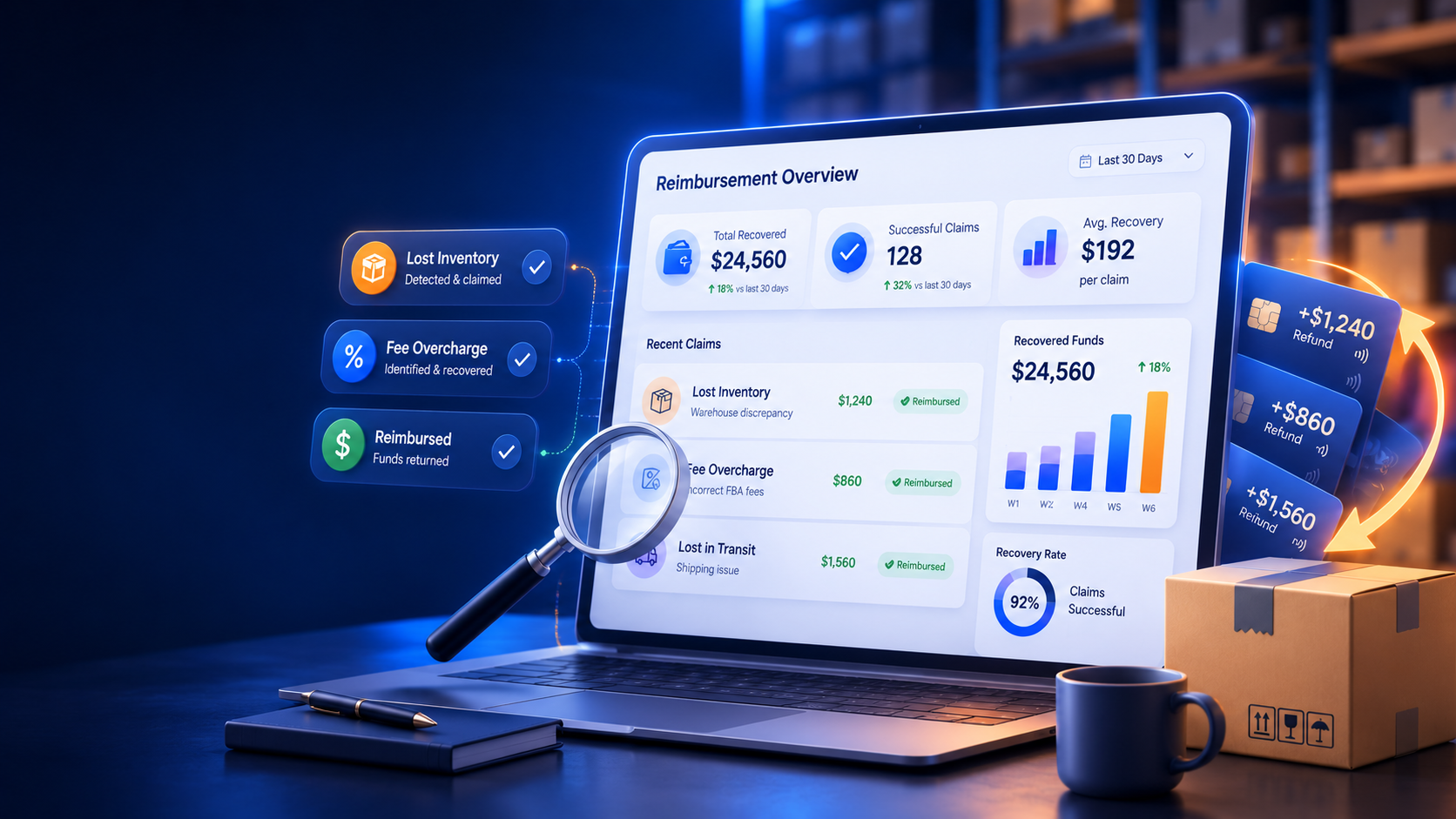
How FBA Reimbursements Work in 2026 — and What Changed
When you send inventory into Fulfillment by Amazon, you hand Amazon responsibility for storing, picking, packing, and shipping your units. Things go wrong at scale: boxes go missing in the warehouse, units get crushed on a conveyor, a customer return is never restocked, or an FBA fee is billed on the wrong measured weight. When the error is Amazon's, you are typically owed money back. That money is an FBA reimbursement — a credit Amazon issues for inventory or fees it lost, damaged, or over-charged.
Historically, reimbursements were one of the most overlooked line items in an FBA business. Amazon does surface some of them automatically, but plenty of discrepancies slipped through unless a seller went looking. What changed the calculus is a set of policy updates Amazon rolled out across 2024 and 2025 that reshaped both how much you get back and how long you have to ask.
Two shifts matter most, as of 2026. First, effective March 31, 2025, Amazon updated its FBA inventory reimbursement policy to reimburse warehouse-lost-or-damaged inventory based on the product's manufacturing (sourcing) cost rather than its selling price — you can accept Amazon's estimated cost or submit your own cost data. Second, the manual claim windows were tightened: reporting on the policy changes that took effect around October 23, 2024 in the US indicates that many FBA claim types dropped from roughly 18 months to about 60 days from the date of the issue. Both figures should be confirmed for your account and marketplace in Seller Central, since Amazon can revise terms at any time.
"Reimbursements used to be the money you found in an old coat pocket — nice, but easy to ignore. After the 2024 to 2025 policy changes, the window to claim is short and the payout math changed. Now it is an operating discipline, not an afterthought."
— Tom Reiter, Product Research & Operations Specialist
The upside for sellers is that the process is now more automated than it used to be. Reporting on the same 2024 updates indicates Amazon proactively reimburses many warehouse-lost-and-damaged items without a manual request. The catch: auto-reimbursement does not catch everything, and when it misses, the shorter claim window means a slow-moving seller can simply run out of time. That gap — between what Amazon pays automatically and what you are actually owed — is exactly what reimbursement tools and services exist to close.
What You Can Actually Claim
Not every loss is claimable, and the basis for the payout depends on when and how the problem happened. The table below groups the most common reimbursable discrepancies and how they are generally handled as of 2026. Treat it as a directional guide — exact claim windows, documentation rules, and payout basis are set by Amazon and can differ by marketplace, so confirm the current terms for your account in Seller Central.
| Discrepancy type | What it means | Typical payout basis (as of 2026) | Where to look |
|---|---|---|---|
| Lost in the warehouse | Units disappear inside a fulfillment center before a customer orders them. | Estimated manufacturing cost (per the policy updated March 31, 2025) | Inventory Ledger |
| Damaged by Amazon | Units damaged in the FC or in Amazon-controlled transit, not by a customer. | Estimated manufacturing cost (same 2025 policy basis) | Reimbursements report |
| Lost or damaged after an order | Item is lost or damaged once a customer has already placed the order. | Order sale price minus applicable fees | Customer returns |
| Customer-return discrepancies | A refunded return is never physically returned, or is returned damaged and not credited. | Case-by-case reconciliation | Returns report |
| Fee, weight & dimension errors | FBA fees billed on an incorrect measured weight or size tier for the unit. | Corrected fee difference | Fee preview / measurements |
| Inbound shipment shortages | Units you shipped in are marked received short of the quantity you sent. | Reconciled on receipt | Reconcile inbound |
*Payout basis and eligibility reflect Amazon policy as reported for 2025 to 2026. Warehouse-lost-and-damaged inventory is generally reimbursed on manufacturing (sourcing) cost — you can accept Amazon's estimate or submit your own documented cost. Items lost or damaged after a customer order are generally reimbursed on the order sale price minus fees. Claim windows for many FBA issues were reported to run about 60 days from the date of the issue as of late 2024 to 2026; always confirm the current windows, documentation rules, and payout terms for your ASINs in Seller Central.
How to Audit and File Within the Policy Windows
Because the claim windows are shorter than they used to be, the whole game is catching discrepancies quickly and filing before they expire. Here is a practical monthly sequence that works whether you do it by hand or let a tool run it for you.
Your FBA Reimbursement Audit Checklist
Pull the source reports on a schedule
Each month, export the Inventory Ledger, Reimbursements, Removal, and Returns reports. These are where lost, damaged, and mishandled units surface — and where you can see what Amazon already reimbursed automatically.
Reconcile inbound shipments
Compare units shipped against units received for every inbound shipment. Shortages are one of the most common — and most missed — reimbursable discrepancies, and they are easiest to prove when your packing records are clean.
Keep sourcing invoices ready
Since the March 31, 2025 policy update, warehouse-lost-and-damaged units are generally reimbursed on manufacturing cost. Having supplier invoices on hand lets you submit your own documented cost rather than defaulting to Amazon's estimate.
Watch the claim windows
Many FBA claim types were reported to run about 60 days from the date of the issue as of late 2024 to 2026. Confirm the exact window for each discrepancy type in Seller Central and file well before it closes — an expired window is money you cannot recover.
File only what is genuinely open
Check what Amazon has already auto-reimbursed before opening a case, then file manual claims for the rest. If you use a tool or service, confirm it reconciles prior payouts first so you avoid duplicate cases that can hurt your account standing.
The recurring theme is documentation and timing. Reimbursements are a legitimate part of running an FBA business — you are recovering money for Amazon's own operational errors — but the burden of proof and the clock are both on you. Whether you keep it in-house or hand it to a specialist, the goal is the same: a repeatable monthly audit that no longer lets valid claims quietly expire.
The Bottom Line on FBA Reimbursements in 2026
FBA reimbursements are money Amazon owes you for inventory it lost or damaged and fees it over-charged. The 2024 to 2025 policy changes reshaped the space: warehouse-lost-and-damaged inventory is now generally reimbursed on manufacturing cost rather than sale price, and the manual claim windows tightened to roughly 60 days for many issue types. Amazon auto-reimburses more than it used to, but it does not catch everything.
Build a monthly audit habit, keep your sourcing invoices ready, and file within the window. If doing it by hand is not realistic, a reimbursement tool or service on a contingency model can do the scanning and filing for you — just weigh audit coverage, the commission terms, and how the provider stays within Amazon's rules. Then verify every claim basis and deadline against your own Seller Central account.
On our sourcing: This article summarizes Amazon's FBA reimbursement policies as reported for 2024 through 2026, drawing on Amazon Seller Central program documentation and industry reporting from that period, including the FBA inventory reimbursement policy update effective March 31, 2025 and the claim-window changes reported around October 23, 2024. Reimbursement rules, payout bases, documentation requirements, and claim windows are set by Amazon and can change without broad notice, and they can differ by marketplace. Commission ranges for third-party reimbursement services are industry-reported and vary by provider. Always confirm the current terms for your account and ASINs in Seller Central, and confirm pricing directly with any provider, before making decisions.
About the Author: Tom Reiter
Tom is AMZToolHub's Product Research & Operations Specialist. He has been launching Amazon products since 2015 and has analyzed 200+ product opportunities across product research, inventory management, profit analytics, and competitive strategy.