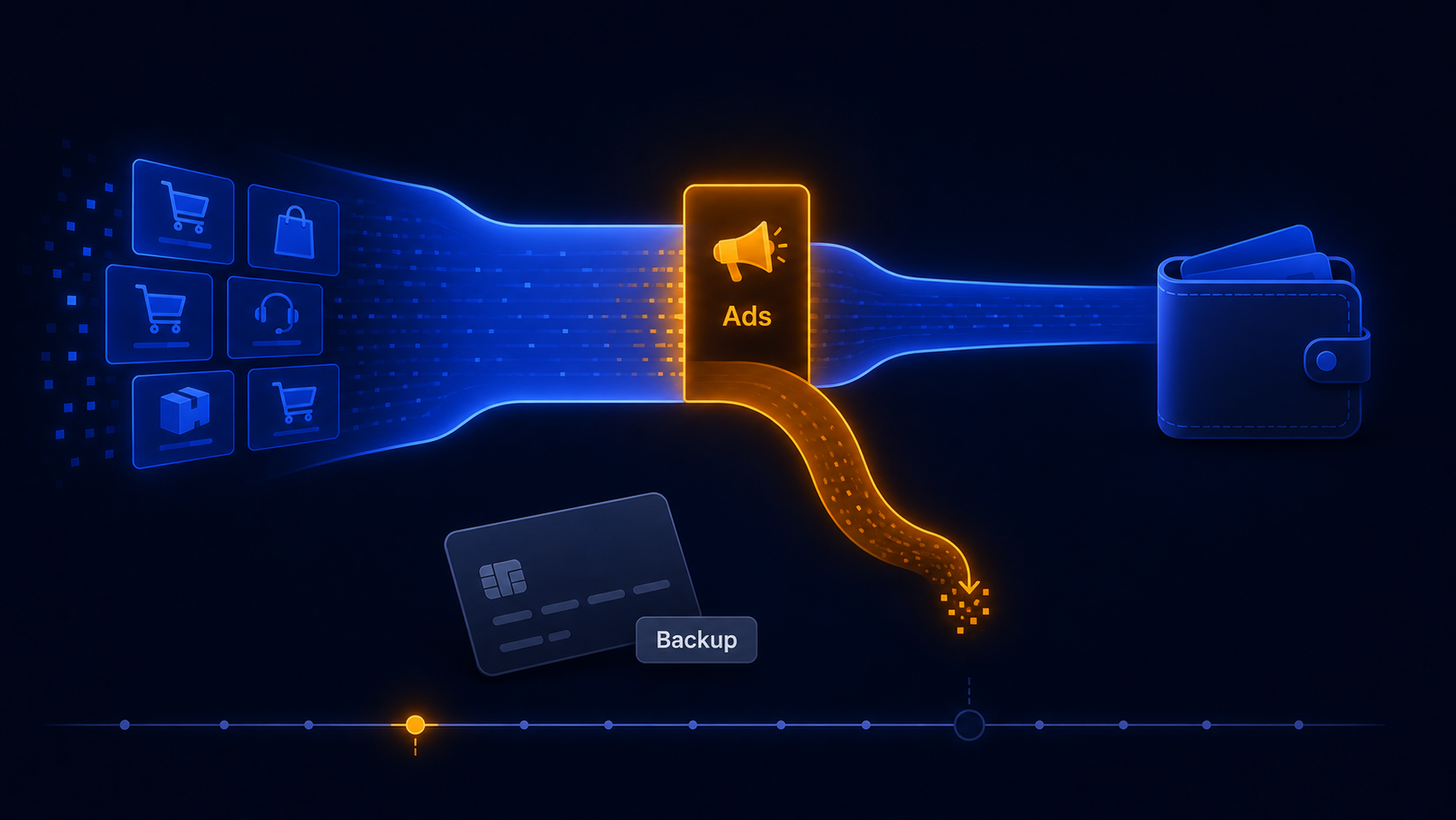
Ad Spend Now Comes Out of Your Payout, Not Your Card
As of August 1, 2026, a group of Amazon advertisers now pay for Sponsored ads a fundamentally different way: ad costs are deducted from the available seller or vendor account balance before disbursement, instead of being charged to a credit card. Amazon's own advertiser payments notice describes the change as applying to a small group of advertisers who have been contacted directly — so this is a targeted migration, not a marketplace-wide switch. If Amazon did not contact you, your billing has not changed.
For the advertisers it does cover, the mechanics are simple and the consequences are not. Amazon's notice states that advertisers who did not select a preference before August 1 had their default payment method automatically updated to deduction from the available account balance. The alternative on offer is Pay by Invoice, where Amazon issues an invoice at the end of each month with payment due 30 days later. An existing credit or debit card stays on file as a backup method so ads do not stop running if the balance is short.
The change has a history. As reported by PPC Land, Modern Retail, and EcommerceBytes, Amazon announced in mid-April 2026 that it was deferring the rollout to August 1 following significant seller pushback, which reporting described as including coordinated protest activity from seller communities. The deferral bought four months; it did not cancel the change.
"Nothing about your ACoS changed on August 1. What changed is when the cash leaves. Sellers who treated a credit card statement date as free working capital just lost that cushion — and most of them budgeted as if it were permanent."
— Maya Patel, PPC & Advertising Specialist
That is the whole story in one line: this is a cash-flow event, not a performance event. Which means the response belongs in your finance planning, not in your bid strategy.
Balance Deduction vs Pay by Invoice
If you were contacted, you have a genuine choice to make, and the default is not automatically the right one for your business. The comparison below reflects the two options as described in Amazon's advertiser payments notice as of August 2026. Confirm what your specific account was offered in the billing section of your Amazon Ads console, since terms can differ by account type and region.
| What to compare | Account balance deduction | Pay by Invoice |
|---|---|---|
| How you pay | Debits and credits handled automatically against your seller or vendor balance | Invoice issued at the end of each month, payment due 30 days later |
| Effect on disbursement | Ad cost is netted out before the money reaches your bank account | Disbursement is not reduced by the ad charge; you settle separately |
| Working-capital timing | Cash leaves earliest — effectively at settlement | Retains a monthly billing cycle plus a 30-day payment term |
| What happens if you do nothing | This is the default advertisers were migrated to on August 1, 2026 | Requires you to actively select it |
| Card on file | Retained as a backup method to avoid interruption | Retained as a backup method to avoid interruption |
As of August 2026, based on Amazon's published advertiser payments notice. Eligibility for Pay by Invoice is set by Amazon and may not be offered to every affected account; availability and terms can change. Verify what applies to your account in the Amazon Ads billing settings.
What to Do This Month If You Were Migrated
The migration is done for accounts that took no action, so the useful work now is confirming your settings and re-forecasting cash. Five steps, in order of urgency.
Your Post-Migration Checklist
Open your Amazon Ads billing settings and confirm the method on file
Check whether your account is now set to account balance deduction or Pay by Invoice, and confirm a valid backup card is attached. Do this before you assume you were affected at all, because the change was described as covering only a small group of directly contacted advertisers.
Re-forecast your next three disbursements with ad spend netted out
Take your recent settlement amounts and subtract the ad spend that used to sit on a card statement. That new number is what will actually land in your bank account, and it is the figure your inventory purchase orders need to be built on.
Check whether Pay by Invoice is available to you and worth taking
A monthly invoice with 30-day terms preserves more of a payment cycle than immediate balance deduction. Eligibility is set by Amazon and may not be offered to every account, so confirm rather than assume, and weigh the reconciliation overhead of a separate payable.
Sequence this against your Q4 inventory buy
August and September are when most sellers commit cash to holiday inventory, and this change lands in exactly that window. If your restock plan assumed a card float for advertising, rebuild the plan before you place the purchase order, not after.
Tighten wasted spend before you cut budget across the board
If cash is tighter, the first lever is search terms and placements that never convert, not a blanket budget reduction that costs you rank going into peak. Pull a search term report, negate the persistent zero-converters, and re-check placement multipliers.
Cutting spend indiscriminately in August to solve a cash timing problem is how sellers arrive at Q4 with a weakened organic and paid position. Fix the forecast first; only then decide whether the budget genuinely has to come down.
On our sourcing: Payment-method details, the August 1, 2026 effective date, the default-migration behavior, the Pay by Invoice 30-day term, and the backup-card provision come from Amazon Ads' published advertiser payments notice as of August 2026. Context on the deferral from mid-April 2026 and the seller reaction that preceded it comes from reporting by PPC Land, Modern Retail, and EcommerceBytes in April 2026. We did not independently verify how many advertisers were contacted, and Amazon described the scope as a small group contacted directly — do not assume your account is included. Terms, eligibility, and availability vary by account and region and can change without notice; confirm your own billing settings in the Amazon Ads console. Tool descriptions are neutral summaries of publicly stated features. This is general information, not financial or tax advice.
About the Author: Maya Patel
Maya is AMZToolHub's PPC & Advertising Specialist. She has managed over $18M in Amazon ad spend across 80+ brands and tests every major advertising and analytics tool so sellers don't have to.